
Who governs?
Ask for the current Steering Committee roster, meeting dates and minutes.
Neighborhood organization accountability
WNA and WCD are free to advocate. The accountability question is whether residents can see who governs, what meetings occurred, how positions were authorized, what evidence supports claims of community backing and how organizational resources were used.
The headlines
You can stop at the headline or follow the issue deeper. Each section below separates what the current record shows from what remains unanswered.
1 · Governance
2 · Meetings
3 · Authority
4 · Resources
5 · Records
New · August 17, 2026
WNA says members “set the direction” for its representation and lobbying. Its August 19 invitation says July feedback provided valuable input to developers. The new meeting brief asks how those statements connect to the governing record.
Ask for the current Steering Committee roster, meeting dates and minutes.
Ask what was sent to developers, who sent it and what vote or action authorized it.
Ask for Treasurer’s reports, the annual financial report and the written audit report.
Latest update · August 9, 2026
The supplemental request is now testing that statement against the specific record categories listed in the August 9 checklist.
WNA response
After receiving the supplemental notice, WNA President John Wood stated that WNA had produced the responsive records in its possession. The response did not identify the outstanding checklist items as already produced, nonexistent or withheld. The requesting member replied that she would treat the email as WNA's position and would await WNA's response to those specific items.
A second response
Uyen Nguyen wrote that WNA is “a CLUB, a voluntary club” and suggested that a member dissatisfied with how WNA operates should start another club.
WNA's own bylaws identify the organization as Woodhaven Neighborhood Association, Inc., a Texas corporation and establish officers, a Steering Committee, monthly meetings, minutes, financial reporting and other governance responsibilities.
Being voluntary does not answer the records question. Membership may be voluntary. The unresolved question is what corporate records exist for governance, decisions and use of organizational resources.
1 · Governing body
WNA's bylaws distinguish the four-officer Executive Committee from a broader Steering Committee that includes officers, committee chairs and the immediate past president.
Yet the August 8 production did not make the complete current Steering Committee roster apparent. The 2025 Annual Meeting minutes identify Brad Anderson as President; under the bylaws, the immediate past president serves ex officio on the Steering Committee. Other produced communications also create role questions: Keith Larson is treated as part of an “Executive Board” in one document but separately from the Executive Committee in another, while Gordon Jackson appears in a last-minute internal meeting without a governing role being apparent from the production.
The question is not whether any of those people may participate in WNA activities. The question is simpler: who currently constitutes the governing body, and what record establishes each person's role?
2 · Meetings
WNA's bylaws contemplate monthly Steering Committee meetings open to members. The production did not make a monthly series of Steering Committee minutes apparent.
One concrete example is the March 17 meeting notice sent on March 5. It listed the location as “TBD (depends on # of turnout)” and told members to contact WNA if they wished to attend. No later location notice or March 17 minutes were apparent in the August 8 production reviewed.
WNA's August 8 response also relies on meetings, stating that disclosures regarding Econautics were made at every public meeting and referring to several meetings the requesting member did not attend. If those meetings occurred, the corresponding notices, dates, attendance records and minutes should make the record clear.
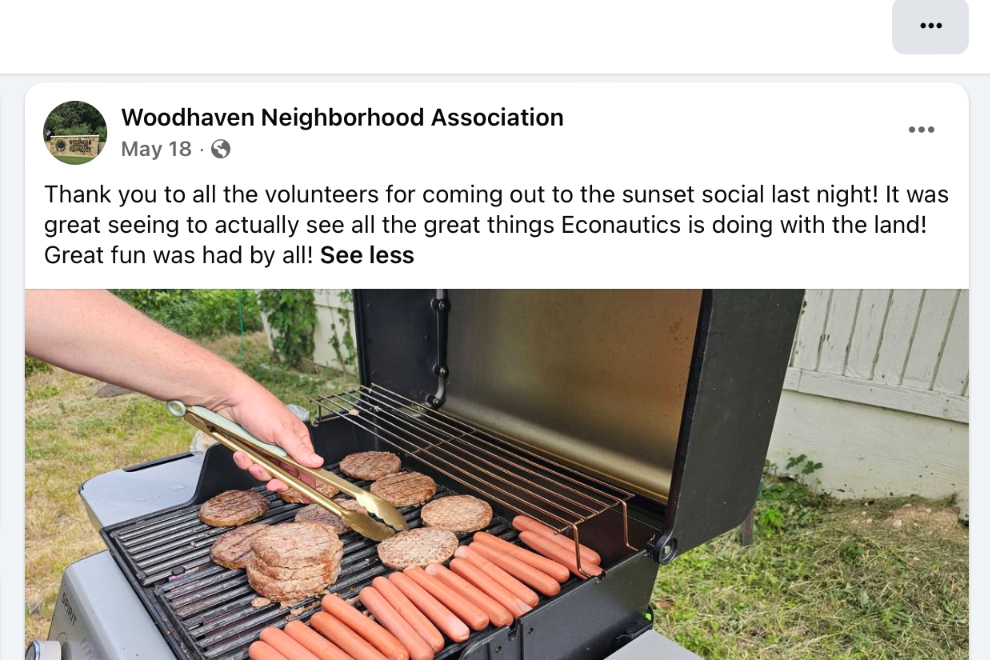
Yard sales, holiday celebrations, block parties, Sunset Socials, National Night Out activities and other community events may be useful WNA activities. They are not substitutes for meetings of the governing body.
The question is not how many WNA events occurred. It is how many actual Steering Committee meetings occurred, who participated and where the minutes are.
3 · Authority
Being WNA's public voice answers who may communicate an Association position. It does not, by itself, answer how a particular policy position became a WNA position.
High Woods Trail
WNA's improvement list identifies sidewalks and traffic-calming measures on High Woods Trail, including possible speed bumps or cushions, as Association priorities. The February 18 minutes say the “WNA steering committee submitted requests” for those items.
The supplemental request asks for the existing record showing how those proposals were adopted as WNA priorities and for the member notice referenced when the proposals drew questions at the July member meeting.
Unanswered: Was there a Steering Committee vote, Executive Committee action, member notice or survey—or did the proposals originate as an officer initiative?
TIF 13
The February 18 minutes discuss using TIF 13 funds for infrastructure. The next day, WNA sent a letter advocating the more specific position that TIF funds could be advanced to a developer rather than provided on a reimbursement basis, along with possible TIF acquisition of former golf-course property.
The supplemental request asks for the corporate record showing when and by whom that financing position was considered or adopted and, if it was an Executive Committee action, when it was reported to the Steering Committee.
Unanswered: Was the position adopted by a governing body, or formulated and communicated under the President's general authority?
4 · Resources & overlapping roles
The public sources prove WNA participation and promotion. They do not prove that WNA paid the event expenses.
5 · Records
WNA did produce records. The follow-up does not call every unlocated item “withheld.” It asks WNA to identify what was already produced, provide what exists, say what does not exist or identify a legal basis for withholding a record.
No WNA-business text or group-message records were apparent in the August 8 production, although relevant electronic communications were expressly requested. The supplemental request is deliberately narrow: it seeks existing messages that constitute or document WNA business, such as corporate decisions, authorization of positions, use of resources or the factual basis for claims of member support.
The financial request is similarly focused on underlying corporate records relevant to how WNA money was received, authorized, spent and recorded. WNA may qualify for the small-nonprofit exemption from separate reporting provisions; the August 9 letter expressly does not rely on those provisions and instead states the member-inspection and filing-entity bases for the request.
Latest status · August 9
WNA says it has produced all responsive records in its possession. The supplemental checklist still asks WNA to map that position to the specific outstanding categories by identifying the file already produced, confirming that no responsive record exists or identifying a basis for withholding it.
A separate organization
Woodhaven Community Development, Inc. has separately taken positions concerning zoning and possible public investment. The Evidence Library contains a City listing, a WCD zoning-support letter, TIF project priorities and the request asking the City to verify WCD's current leadership, meetings, membership, board selection and authority for its public positions.
The site does not treat WNA and WCD as interchangeable. Overlapping people or interests do not answer the governance question for either organization.
The standard
Neighborhood organizations can advocate. Residents should still be able to identify the governing body, the meeting record, the authorization behind a public position and the evidence behind a claim of community support.